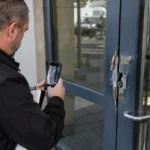
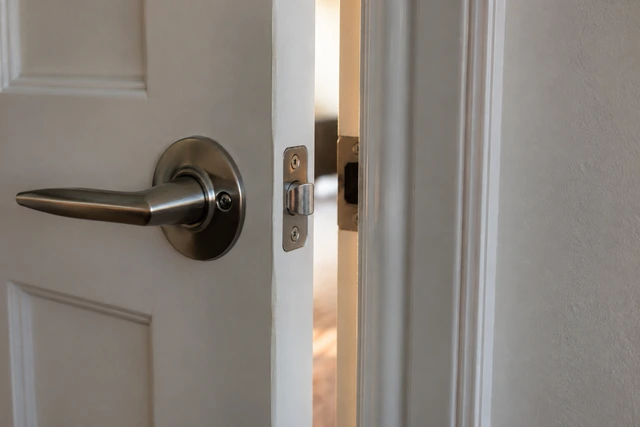
A door can appear fully shut and still fail to provide dependable security. The leaf may sit flush with the frame while the latch is only partly engaged‚ the strike may be misaligned or the closer may stop just before the locking point. Because the problem is subtle‚ it can remain unnoticed until someone pushes on the door or a security check reveals that the opening never truly latched.
Where the locking mechanism itself is worn or damaged‚ door lock repair may restore normal engagement. But visual closure should never be used as the only test. Reliable security depends on the relationship between the lock‚ strike‚ frame‚ hinges and closing system.
Partial latch engagement
The latch bolt needs to enter the strike opening far enough to resist normal pressure. If only the tip catches‚ the door may produce a click and look closed without being properly held.
Misalignment can cause shallow engagement even when the lock operates normally. A sagging leaf may bring the latch too low. A shifted frame can move the strike sideways. Thick or displaced weatherstripping can stop the leaf short of its intended position.
One simple observation is whether the door becomes more secure when pushed or pulled after it appears closed. If another small movement produces a deeper click‚ the first closing cycle was incomplete.
Frame alignment and the security line
The frame provides the fixed point that the locking hardware relies on. When it moves‚ the strike moves with it. A latch adjusted to follow a shifting frame may continue working temporarily‚ but repeated corrections can reduce the quality of the fit.
If the frame itself has loosened‚ cracked or moved out of square‚ door frame repair may be more appropriate than continuing to reposition the strike.
- Uneven Gaps can reveal changes in frame geometry.
- Loose Strike Plates may reduce dependable engagement.
- Fresh Scrape Marks show where the latch is contacting.
- Visible Flex can indicate weakened frame support.
- Repeated Adjustments suggest an unresolved underlying cause.
Closer behaviour and false closure
A closer can bring a door almost completely shut but still leave the latch outside the strike. This often happens when the final latching force is too low to overcome seals‚ air pressure or mechanical resistance.
The opposite problem also occurs. Excessive speed can make the door slam into the frame and rebound slightly. From a distance it may still look closed‚ but the latch may not remain engaged.
The correct response is not automatically more force. The leaf should first move freely‚ and the latch should align properly. Only then can the closer be adjusted to complete the cycle without slamming.
Urgent security problems after damage
Forced entry‚ impact or sudden hardware failure can change the geometry of an opening immediately. A door may still hang in place while the frame is split‚ the strike is torn loose or the lock no longer engages securely.
In these circumstances‚ emergency door repair may be necessary to secure the opening and prevent further damage. Temporary closure should not be mistaken for restored security‚ particularly when the frame or locking area has been compromised.
Documentation is useful after an incident. Photographs of the strike‚ frame‚ hinges and damaged edges can help establish what changed and support a more accurate assessment.
Main entrance wear and daily habits
Frequently used front entries often develop compensating habits before anyone reports a fault. People may pull the handle upward‚ push the door twice or wait for a second click. Those habits are signs that the opening is no longer completing its normal closing sequence.
Where the issue affects the principal access point‚ front door repair may involve alignment‚ hinges‚ locks and closing hardware together. The objective is a door that secures itself consistently without requiring a special technique.
A reliable entrance should behave the same way for different users. If one person knows the trick needed to make it lock‚ the system is already depending on behaviour rather than hardware.
Weather‚ pressure and intermittent security
Some entrances latch correctly only under certain conditions. Cold weather can stiffen seals. Humidity can change wood clearances. Wind and building pressure can either assist or resist the closer.
This can create an intermittent problem that is difficult to reproduce during a service visit. Keeping notes about temperature‚ time of day and HVAC operation can help identify the pattern.
For properties in the eastern GTA‚ work such as door repair in Scarborough may involve evaluating those local exposure conditions alongside the mechanical opening.
A security check based on function‚ not appearance
A useful inspection confirms that the door closes completely‚ the latch extends fully‚ the frame remains stable and the lock operates without lifting or forcing the leaf. The same test should be repeated through several cycles because an intermittent failure can be as important as a constant one.
Lawrence Doors can assess entrances across Toronto and the GTA that appear closed but do not latch reliably. Identifying the source early helps protect the lock‚ reduce repeated wear and restore a closing cycle that provides real security rather than only the appearance of it.