A door frame can shift very slowly for months or years before the change becomes obvious. At first‚ the only clue may be a latch that needs an extra pull‚ a narrow gap at one corner or a new rub mark near the threshold. As movement continues‚ several symptoms may appear together because the frame defines the geometry that the door‚ hinges‚ lock and seals depend on.
When the surrounding structure has moved but remains serviceable‚ door frame repair may restore stability and alignment without treating each symptom separately. The useful distinction is between a one-time adjustment and an opening that continues to change because its connections‚ materials or supporting structure are deteriorating.
Gradual movement in an apparently rigid structure
Frames look fixed‚ but they are connected to buildings that expand‚ contract‚ settle and respond to moisture. Fasteners can loosen under repeated closing loads. Wood can swell or dry. Metal can corrode around anchors. Impact can distort one side of the opening without creating an immediately visible crack.
Small movements are often absorbed by the available clearances. Once those clearances are used up‚ the door starts making contact with the frame‚ threshold or strike. That is why a problem can seem to appear suddenly even though the underlying movement has been developing for a long time.
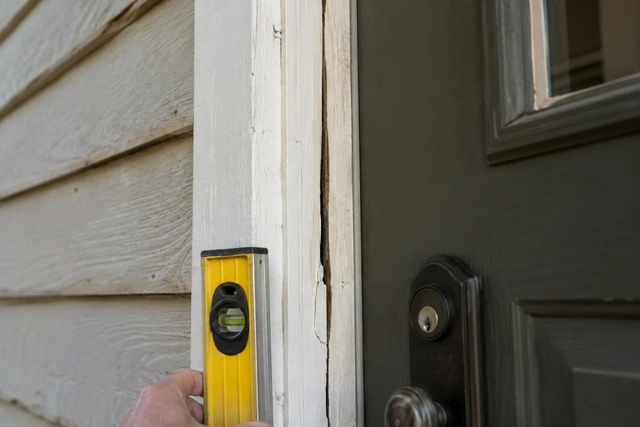
The pattern of gaps around the leaf is one of the most useful visual clues. A stable opening normally maintains reasonably consistent clearances. A gap that widens at the top and narrows at the bottom may indicate sag or frame change rather than a lock problem.
Fastener fatigue and repeated closing loads
Every opening cycle transfers force through hinges and into the frame. On a lightly used interior opening‚ those loads may be modest. At a busy exterior or service entrance‚ they are repeated constantly.
Loose screws are sometimes tightened as a quick fix‚ but repeated loosening deserves investigation. The fastener may no longer have a sound substrate‚ the hinge may be carrying an uneven load‚ or the frame may be flexing. Simply using a larger screw without addressing the cause can shift the stress to another point.
- Recurring Loose Screws can indicate movement beyond ordinary maintenance.
- Cracks Near Hinges may show concentrated loading.
- Strike Misalignment can reveal a change on the opposite side of the frame.
- Uneven Weatherstripping Compression suggests changing geometry.
- Visible Flex during closing points to weakened support.
Moisture and material deterioration
Exterior frames live at the boundary between indoor and outdoor conditions. Water can reach lower sections through failed seals‚ poor drainage or repeated snow accumulation. Wood may soften or swell. Metal can corrode where coatings have failed. Freeze-thaw cycles can enlarge small gaps around anchors and joints.
Once the material around a connection deteriorates‚ hardware adjustment alone may not hold for long. If the structure can no longer maintain alignment or provide secure fastening‚ door frame replacement may be more appropriate than repeated local corrections.
That decision should be based on condition‚ not age alone. An older frame can remain sound‚ while a newer one exposed to chronic moisture or impact may require more extensive work.
Exterior exposure and seasonal changes
Temperature swings make marginal alignment problems more noticeable. A door may operate normally during a dry week and bind after heavy rain. Cold weather can stiffen seals and alter closer behaviour‚ while summer humidity can affect wood components.
Where the leaf and surrounding weather-facing elements are affected together‚ exterior door repair can address damage caused by exposure while the frame is evaluated separately for movement.
Tracking when symptoms occur can help distinguish temporary seasonal behaviour from progressive structural change. A problem that disappears completely in stable weather may have a different cause from one that worsens steadily regardless of conditions.
Main entrances reveal movement quickly
Frequently used front entrances are especially sensitive because they combine high cycle counts with security‚ weather sealing and appearance requirements. Even a small shift can affect multiple functions at once.
A latch may begin missing the strike. The sweep may drag. A closer may need more force to overcome the new resistance. Staff or occupants may compensate by pulling harder‚ which adds further load to hinges and the frame.
When these symptoms occur at the principal access point‚ front door repair may involve correcting the visible operational issues while checking whether frame movement is the underlying reason they developed.
The danger of repeated symptom-only adjustments
Moving the strike plate‚ trimming a rubbing edge or increasing closer force can make a door usable again. Those changes are sometimes appropriate‚ but repeated adjustments can mask continuing movement.
If the strike has been repositioned several times‚ or if the door needs a new correction every season‚ the history itself becomes diagnostic evidence. The frame‚ hinge mounting and surrounding construction should be reviewed rather than assuming each episode is unrelated.
A simple maintenance record can be valuable:
- Photographs Of Gaps help document gradual change.
- Dates Of Adjustments show how often alignment is being corrected.
- Weather Notes can reveal seasonal patterns.
- Impact Events may explain sudden movement.
- Hardware History helps distinguish component wear from structural change.
Older buildings and accumulated change
In established neighbourhoods‚ entrances may have been modified several times over decades. New locks‚ closers‚ thresholds or replacement leaves may have been fitted to frames that were not originally designed for them. Building settlement can add another layer of variation.
Work such as door repair in Old Toronto can therefore require careful diagnosis of both current hardware and older surrounding construction. The aim is not to assume that age is the problem‚ but to understand how previous changes interact with the present opening.
Stable geometry as the real objective
The purpose of frame work is not merely to make the door close on the day of service. The opening should remain stable enough that hinges‚ locks‚ closers and seals can operate within their intended clearances.
A sound assessment checks anchoring‚ material condition‚ alignment and the forces acting on the frame before recommending adjustment or more extensive work. Lawrence Doors can evaluate shifting and misaligned openings across Toronto and the GTA and explain which part of the system is moving and why.
Early attention is especially useful when the first signs are minor. A small change in the gap or latch position can be much easier to address than a frame that has progressed to visible distortion or unreliable security.